
Across the African continent, the traditional pipeline from schooling to stable employment is fundamentally fractured, leaving a generation of young people to navigate a precarious and non-linear path to professional security.
Communities surrounding Ol Pejeta are home to approximately 56,000 people living across 21 neighbouring community areas, with more than a third of the population made up of youth aged between 15 and 34. Most families depend on rain-fed agriculture and livestock keeping for their livelihoods, but recurring droughts and the effects of climate change continue to make farming increasingly unpredictable. Combined with a poverty rate of nearly 58%, almost twice the national average, these challenges leave many young people with limited opportunities to pursue higher education or secure meaningful employment.
Since 2006, Ol Pejeta has invested in education by providing more than 800 secondary school scholarships to students from neighbouring communities. While these scholarships have enabled hundreds of learners to complete secondary school, another challenge soon became evident.
Only about 22% of secondary school graduates progress to university.
For many young people, secondary school marks the end of their formal education, yet the job market increasingly demands practical, technical skills rather than mere academic prowess.
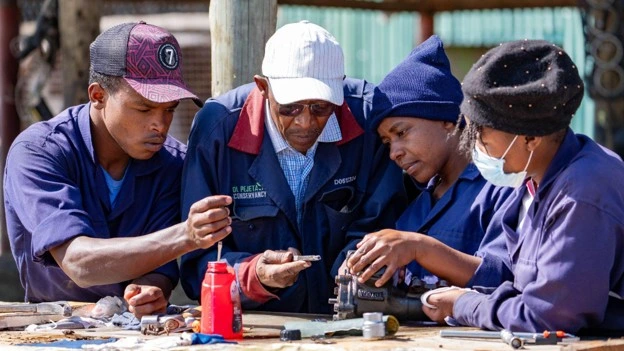
Just a few kilometres away, Nanyuki town continues to expand rapidly. New homes, businesses and infrastructure projects have created growing demand for skilled artisans, mechanics, welders, electricians and construction workers. Ironically, many of these jobs are filled by skilled workers from outside the region because local youth often lack access to quality technical training and modern equipment.
At Ol Pejeta, we believe this gap represents a real opportunity for the youth.
Technical and Vocational Education and Training, (TVET) is a system of education that focuses on practical, hands-on skills to prepare young people for specific trades, occupations, and jobs. Across Kenya, TVETs are helping build the skilled workforce needed to drive industrial growth while reducing youth unemployment.
Today, that vision is already taking shape at Ol Pejeta’s Kamok garage.
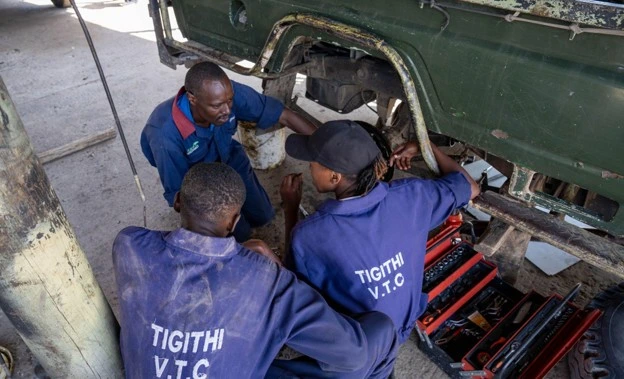
Thanks to donors, we are currently hosting 10 TVET students on industrial attachment, giving them the opportunity to learn first hand from experienced mechanics and technicians who maintain Ol Pejeta’s fleet of vehicles and heavy machinery.
Every day presents a new lesson.
Some mornings begin with the rhythmic clatter of wrenches as trainees service Ol Pejeta’s fleet before the vehicles roll out into the conservancy. Other days demand a deeper dive into the mechanical grit: diagnosing stubborn engine faults, swapping out battered suspension parts, or mastering the preventive maintenance that keeps the conservancy’s heart beating. Guided by veteran inhouse mechanics, these apprentices are trading the sterile predictability of a textbook for the grease-stained, high-stakes reality of a functional workshop—an education no classroom could ever replicate.
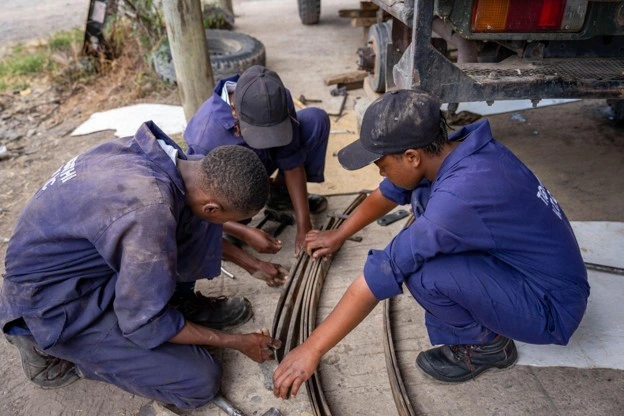
For many of the students, it is their first experience working in a professional mechanical workshop.
“When I started the attachment, I had only worked on training models in school,” says Alice Njeri, one of the trainees. “Here, I’ve learnt how to troubleshoot real vehicle problems, work safely as part of a team and understand what employers expect from us. Despite being a girl, every day gives me more confidence that I can build a career as a mechanic.”
Beyond technical skills, the attachment programme is nurturing discipline, teamwork, communication and problem-solving skills that employers value across every industry.
“The students arrive eager to learn,” says our workshop supervisor Mr Paul Tanui. “We don’t just teach them how to repair vehicles; we teach them how to think through problems, work professionally and embrace team work. Watching their confidence grow over the course of their attachment is incredibly rewarding to me. I believe they will become great people in the industry.”
Building on the success of these industrial attachments, Ol Pejeta just launched the same structured six-month apprenticeship programme for masonry courses in August 2026.
The second programme will enroll between 15 students in a unique training model that combines 50% classroom learning at accredited Technical and Vocational Colleges with 50% practical training at Ol Pejeta Conservancy. Apprentices will graduate with government-recognized qualifications, valuable workplace experience and industry-ready skills that significantly improve their chances of employment.
This is about far more than filling jobs.
By equipping local youth with technical skills, we are creating pathways into the conservation economy itself. Whether maintaining safari vehicles, repairing machinery, constructing wildlife fences or supporting tourism infrastructure, these young people become active contributors to conservation while earning sustainable livelihoods for themselves and their families.
Our ambition extends beyond Ol Pejeta.
The true measure of success of this pilot won’t just be the engines fixed at Ol Pejeta, but the blueprint it creates for wildlife conservancies across Kenya to follow this model. Ol Pejeta’s vision is to cultivate a skilled workforce drawn directly from the communities bordering the fences. By investing in local talent, we are doing more than just tackling youth unemployment; we are rewriting the conservation playbook. It’s a model where the people living shoulder-to-shoulder with wildlife aren’t just bystanders, but direct beneficiaries of the very ecosystems they help protect and the subsequent opportunities created.
“Technical skills create dignity, independence and opportunity,” says Kelvin Gitau, Senior Education Officer at Ol Pejeta Conservancy. “Not every young person will attend university, but every young person deserves the chance to build a meaningful career. Through TVET and apprenticeships, we are helping young people gain the confidence, experience and skills they need to shape their own future.”
Every repaired engine, every newly acquired skill and every confident graduate represents another step towards stronger communities and a more sustainable future.
By supporting Ol Pejeta’s education and skills development programmes through visiting the conservancy, making a donation or sharing our story you are helping create lasting opportunities for young people across Laikipia.
Together, we are investing in more than technical training.
We are investing in the future.
Written By Kevin Kipruto