
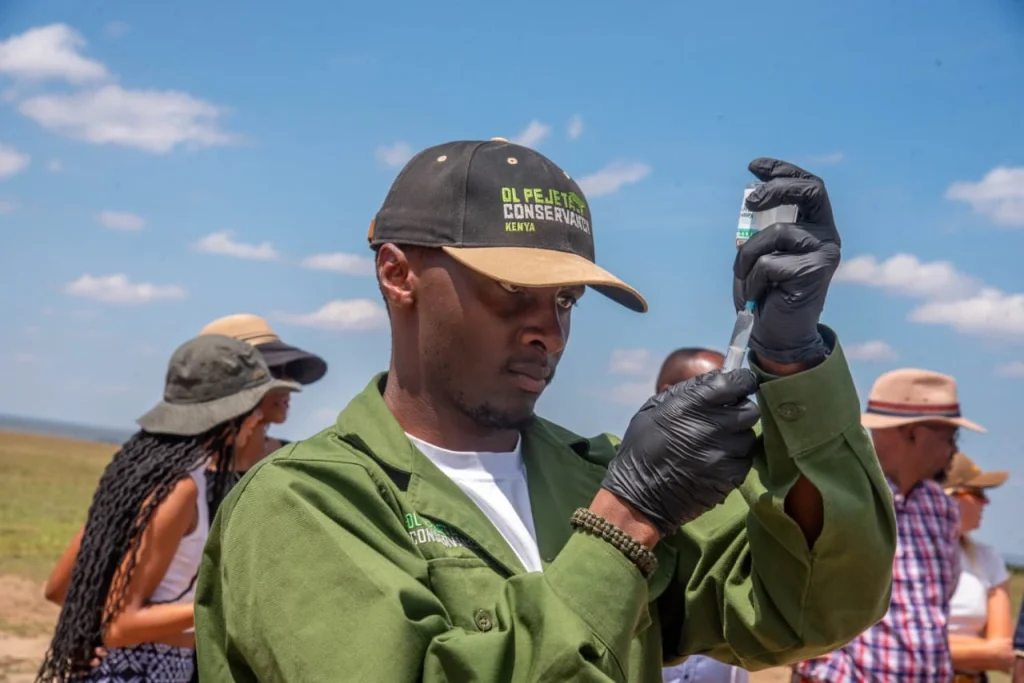
My day starts at 5:30 a.m. Before the sun rises over the Laikipia plains, I’m already on the move. First stop is the Sweetwaters Chimpanzee Sanctuary. Checking on the chimpanzees is never just routine. It’s grounding. It reminds me why I chose this path. From there it’s back to the office to write up reports, then out across the conservancy to check on the last two northern white rhinos, Najin and Fatu, and Baraka, our blind black rhino.
Some days are calm. Others turn on a moment. This was one of the hardest yet.
At 8:30 a.m. a radio call broke the quiet. Rangers had spotted a limping elephant in the acacia woodland. Within minutes we were moving. Mr Chris, known to everyone as “Bwana Simba,” was behind the wheel. Seven kilometres into rough terrain we found our elephant near Tangi Mbili, half-hidden behind thorny branches. As we manoeuvred closer, a male lion stepped out of the shade and watched us. We clocked him, then turned back to the elephant. Through the tall grass we got close enough to see a wound on his left foot before he raised his head and slipped into the thicket.
Back at the office I called Dr Jeremiah Poghon, head vet of the KWS Mt Kenya Mobile Veterinary Unit. One look at the footage and we agreed: this couldn’t wait. Sedating an African elephant is one of the most demanding procedures in wildlife medicine. At up to seven tonnes, positioning is everything as the animal’s own weight can restrict its breathing. By 10 o’clock the mobile vet team had arrived and we were ready.
What followed was hours of frustration. Despite his injury the elephant moved fast, disappearing into dense bush again and again. We sent up a drone, watched the batteries die one by one, and kept searching under a punishing sun. Around 2 o’clock, we called in a helicopter. Dr Poghon went up with the pilot, Mr Andrew. At 3:50 p.m. the radio crackled: elephant found. Seconds later, the dart was deployed.
The team worked fast. The wound was cleaned and treated, rangers kept water flowing over his body, and we watched his breathing the whole time. By 4:15 p.m. it was done. He got up slowly, found his feet, and walked back into the bush. Nobody said much. We didn’t need to.
I always say my day ends at 6:00 p.m., but honestly it never really does. I didn’t set out to be a wildlife vet, but after graduation I kept asking myself why there were so few of us doing this work. The job is hard, unpredictable, and sometimes frightening. But these animals have no voice, and showing up for them is the least we can do. Wildlife medicine isn’t just a career. It’s a responsibility. And every morning at 5:30 a.m., it starts again.
Stories like this happen every week at Ol Pejeta. Sign up to our monthly enewsletter to receive them directly. https://bit.ly/
Written By Dr. Joseph Mbuthia
Resident Vet – Sweetwaters Chimpanzee Sanctuary