
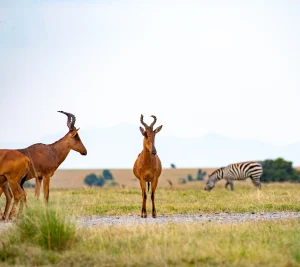
The hartebeest is a large African antelope known for its long face, high shoulders, and uniquely shaped horns. Built for open plains, it is one of the fastest and most enduring antelopes in Africa. Mainly found in savannas and grasslands, these herbivores graze almost exclusively on grasses. There are five subspecies of the hartebeest including Tora, western, Bubal, Lichtenstein’s and Coke’s heartbeast. Both males and females have horns. They are fast runners, and have very sharp eyesight.
Worrying Population Drop
Since 2008, a total of 127 hartebeest deaths have been reported in Ol Pejeta Conservancy. 92 of these deaths were predation cases. While the cause of deaths was not identified in another 27 cases, other causes of death were electrocution (4), a road kill, an illness, a fighting incident and a natural old-age-related death. Lions contributed over half of the predation cases. This is according to the 2025 our Research & Ecological Monitoring Unit report.
Ol Pejeta has monitored Jackson’s hartebeests since 2008. The research work has revealed that these herbivores are prone to predation from lions and other carnivores during periods of dusk, night and dawn. To ensure that we curb all this, lions have been collared to allow overlaying lion activities with that of Hartebeest – giving a very clear idea of the landscape of risk for the hartebeest.
Over the past decade, a tremendous population decline is raising serious concerns amongst our programs department. Population estimates indicate a reduction of more than 60–70%, with current numbers in Laikipia estimated at 700–1,000 individuals, approximately 14% of which occur on Ol Pejeta Conservancy. The causes of this decline are likely mutifactorial. Understanding patterns of survival, seasonal movements, and habitat use is essential for informing management interventions aimed at stabilizing the population. This knowledge gap formed the foundational bedrock of the Laikipia Hartebeest Conservation project – an initiative that aims to ensure this species is saved from the brink of extinction.